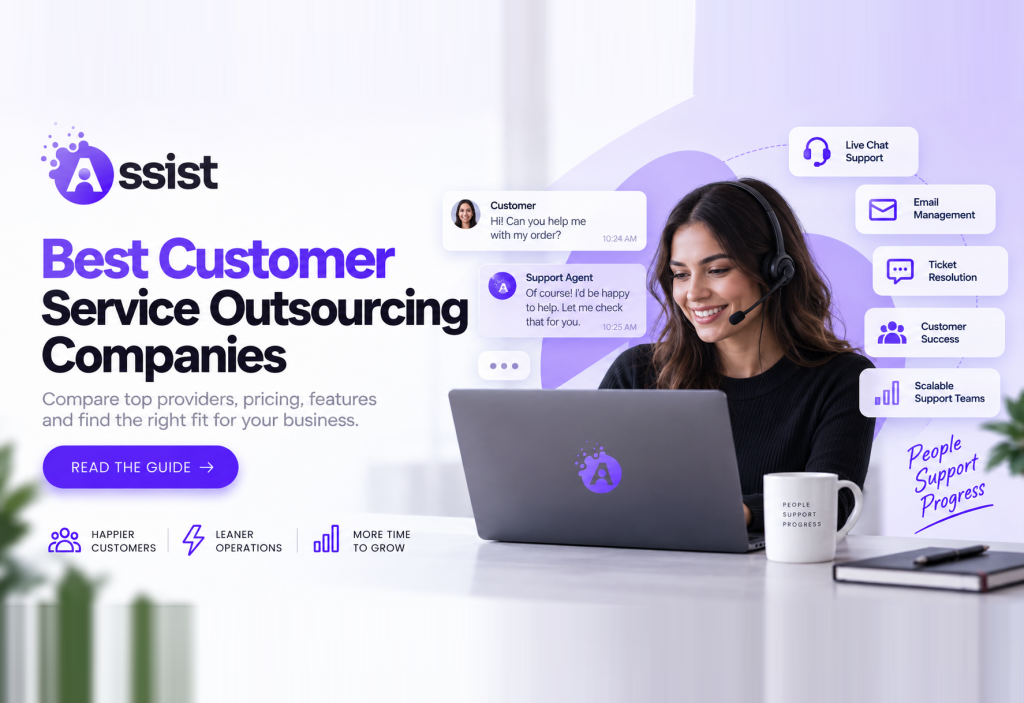

A support queue can swallow the whole day before you’ve touched anything else on the list. The right outsourced team takes that load off without making customers feel handed around a call center. The catch is that “customer service outsourcing” covers two very different markets: enterprise BPO firms built for thousand-seat programs, and smaller, matched-staffing models built for a business that needs one or two people who actually know the brand.
One disclosure, stated plainly: we’re Assist World, and we’re first on this list. The comparisons stay honest anyway, including where a bigger provider fits you better than we do.
The Short Version
If you’re a small or mid-sized business, most of the providers below are built for a scale you don’t need yet, and their pricing reflects that. Match the provider to your actual size, not the size of their client logos.
| Provider | Best for | Pricing | Ask before signing |
|---|---|---|---|
| Assist World | Entrepreneurs, startups, and SMBs who want support paired with day-to-day operations | $1,800 to $3,000/mo full-time (about $12 to $17/hour) | Which matched candidate fits your workflow? |
| Hugo | Fast-growing SaaS, fintech, and digital health companies | Starts at $11/hour per agent | What’s covered at that rate versus billed separately? |
| Teleperformance | Major enterprises needing global, multilingual coverage | Custom quote, not published | What’s the minimum seat commitment? |
| Concentrix | Large CX programs that also want analytics and automation | Custom quote, not published | Is automation work billed separately from support? |
| TTEC | Enterprises combining support with digital transformation projects | Custom quote, not published | Where does the support contract end and the consulting engagement begin? |
| TaskUs | Tech companies needing digital-first customer experience support | Custom quote, not published | What’s the minimum program size? |
| Helpware | Companies that want omnichannel support with tech integration | Custom quote, not published | How is pricing structured: seat, task, or outcome? |
| Foundever | Mid-market and enterprise firms wanting broad geographic reach | Custom quote, not published | Which delivery locations actually staff your account? |
Almost everyone past the first two rows keeps pricing private. That’s normal at enterprise scale, but it means you need a clear scope before you take a sales call, not after.
Now the detail.
1. Assist World: Matched Support for Entrepreneurs, Startups, and SMBs
We’re Assist World, so read this section with appropriate skepticism, then hold every provider on this list, including us, to the same standard.
We’re not an enterprise BPO, and that’s the honest starting point. We match businesses with vetted virtual assistants who can handle customer support work, phone, email, chat, order and refund handling, alongside the administrative and operational tasks that pile up around it. Full-time support typically runs $1,800 to $3,000 a month, about $12 to $17 an hour depending on the role and experience level.
That’s a different model from the enterprise names further down this list. You’re not buying a seat inside a thousand-agent program with a shift schedule set by someone else. You meet at least two matched candidates and choose who you work with, and the same person who answers your customers can also handle your inbox, scheduling, or order processing during quieter hours instead of sitting idle.
The math behind this is worth naming directly. A full-time in-house support hire in the US typically runs $5,000 to $8,000 a month once salary, taxes, and benefits are added up, versus $3,000 or less for a virtual assistant handling the same volume. That gap is real, and it’s also why the cheapest hourly rate on any list like this isn’t automatically the smartest pick: a provider undercutting everyone on price usually has the least vetting behind it.
The honest limitation: if you need hundreds of agents, 24/7 coverage across a dozen languages, or deep CX analytics tooling, that’s a genuinely different program than what we build. The names below are built for exactly that scale. We’re built for the business that needs a handful of trained, reliable people who know the brand, not a call floor.
See our virtual assistant services for the full task list our assistants take on, including customer support, or book a free consultation to get matched.
2. Hugo: Dedicated Agents for Fast-Growing Companies
Hugo sells dedicated, full-time customer support agents on month-to-month contracts, priced at $11 an hour per agent. That’s a published, checkable number, which is rare on this list past the first entry.
The company positions itself around fast-growing SaaS, fintech, digital health, and marketplace businesses, and advertises support across voice, email, chat, social, and in-app messaging, plus integration with common help desk and CRM tools. It doesn’t publish an exact count of supported platforms, so confirm your specific stack works before assuming compatibility.
The tradeoff at this price point is the one you’d expect: a flat per-agent rate buys a trained generalist, not necessarily someone who also handles adjacent operational work the way a smaller, matched-placement model does.
Hugo fits a growing company that wants dedicated, full-time agents at a transparent hourly rate without negotiating a custom enterprise contract.
3. Teleperformance: Global Scale for Major Enterprises
Teleperformance is one of the largest customer experience outsourcing companies in the world, built for major enterprise clients that need coverage across many countries and languages at once. Pricing isn’t published; enterprise programs at this scale are quoted individually based on volume, languages, and channels.
The scale is the whole point here. If your support volume genuinely requires hundreds or thousands of agents across multiple regions, Teleperformance has the infrastructure and language coverage to staff that. It’s not built for, and isn’t priced for, a business that needs a handful of people.
Teleperformance makes sense when your bottleneck is genuinely global scale, not when you’re trying to avoid hiring your first two or three support staff.
4. Concentrix: CX Programs With Analytics and Automation
Concentrix runs large-scale customer experience programs and layers in analytics, automation, and technology consulting alongside the support work itself. That combination suits an enterprise that wants a single partner handling both the agents and the systems around them.
Like Teleperformance, pricing is custom and not published. Ask specifically whether automation, analytics, and consulting work are billed separately from the core support program, since bundling those into one quote can obscure what you’re actually paying for.
Concentrix fits a large CX program that wants technology and process work handled by the same partner running the support queue, not a small business looking for a handful of trained agents.
5. TTEC: Support Paired With Digital Transformation Work
TTEC combines traditional customer support outsourcing with broader digital transformation engagements, positioning itself for enterprises that want both the day-to-day support work and a partner for larger technology or process change initiatives.
Pricing is custom and not published. Because TTEC’s engagements often span both a support program and a consulting-style transformation project, clarify where the support contract ends and the transformation engagement begins before signing, so timelines and costs from one side don’t quietly bleed into the other.
TTEC is a reasonable fit for an enterprise already planning a broader operational or technology shift alongside its support outsourcing, not for a business that just needs help answering customers.
6. TaskUs: Digital-First Support for Tech Companies
TaskUs focuses on digital customer experience support for technology companies, positioning itself around the kind of fast-moving, product-led businesses that need agents comfortable with in-app support, trust and safety work, and digital-native channels.
Pricing is custom and not published. Ask about minimum program size directly. TaskUs is generally built around larger engagements than a small business’s support queue.
TaskUs fits a technology company that needs digital-first support at meaningful scale, not a small operation testing outsourced support for the first time.
7. Helpware: Omnichannel Support With Technology Integration
Helpware builds omnichannel customer support programs with an emphasis on technology integration and process optimization, positioning itself as a partner that adapts its systems to a client’s existing tools rather than requiring a client to adopt new ones.
Pricing isn’t published and depends on channels, volume, and the technology work involved. Ask directly how the pricing model is structured, seat-based, task-based, or outcome-based, since Helpware’s flexibility on delivery model extends to how it prices engagements too.
Helpware fits a company that wants omnichannel coverage built around its existing tech stack rather than a one-size-fits-all program.
8. Foundever: Broad Geographic Reach for Mid-Market and Enterprise
Foundever (formerly Sitel Group) is an established BPO with a wide global delivery footprint, positioned for mid-market and enterprise firms that want an experienced provider with options across many delivery locations.
Pricing is custom and not published. With a provider this size, ask specifically which delivery locations will actually staff your account, since broad geographic reach on a company’s website doesn’t guarantee your program lands with the team or region you expect.
Foundever fits a mid-market or enterprise business that wants an established, large-scale provider and has the volume to make that scale worthwhile.
What to Check Before You Hire a Customer Service Outsourcing Company
Write down what the team must actually handle before you take a single sales call. A vague request for “customer support” gets you a vague quote.
- Volume and channels. Count tickets by week and by channel, and know which channels (phone, email, chat, social) you actually need covered.
- Escalation rules. Decide what the outsourced team can resolve on its own and what must come back to your internal team, especially anything touching payments, account access, or legal complaints.
- Data and access. Know what customer data the team can see, how access is granted, and how it’s removed when the engagement ends or an agent turns over.
- Pricing structure. Hourly, seat-based, task-based, or custom quote, and what’s included at that rate versus billed as an extra.
- Scale fit. A provider built for thousand-seat enterprise programs is rarely the right fit, or the right price, for a team that needs two or three trained people.
Start with a small pilot on your highest-volume, lowest-risk ticket type before handing over the full queue. What that pilot reveals about quality and communication matters more than anything in a sales deck.
FAQ
What do customer service outsourcing companies actually do?
They handle some or all of a business’s customer interactions: email, phone, chat, social messages, order checks, refunds, and escalations. Scope varies enormously by provider, from a matched virtual assistant handling support alongside other operational work to a thousand-agent enterprise program. Get a sample workflow, not just a service list, before comparing providers.
How much does customer service outsourcing cost?
It depends heavily on scale and model. Assist World runs $1,800 to $3,000 a month for full-time matched support, about $12 to $17 an hour. Hugo publishes a $11-an-hour-per-agent rate. The larger enterprise BPOs (Teleperformance, Concentrix, TTEC, TaskUs, Helpware, Foundever) don’t publish pricing; expect a custom quote based on volume, channels, and languages.
Is a small business better off with a virtual assistant or an enterprise BPO?
For most small and mid-sized businesses, a matched virtual assistant model fits better than an enterprise BPO built for thousand-seat programs. You get someone who learns the brand and can flex into adjacent operational work, rather than a seat inside a much larger, more rigid program priced for a different scale entirely.
Is outsourcing customer service safe?
It can be, when access, data handling, and escalation rules are clearly defined and enforced. Know what data the team can see, confirm how access is removed when someone leaves the account, and keep anything involving payments, legal issues, or sensitive judgment calls with staff you’ve trained directly.
When should a business move from an enterprise BPO down to a smaller provider, or the reverse?
Move toward a smaller, matched-staffing model when your volume doesn’t justify a large program’s minimums and you want support paired with other operational work. Move toward an enterprise BPO when your support volume genuinely requires hundreds of agents, multiple languages, or 24/7 coverage across time zones that a small team can’t realistically staff.
Where to Go From Here
The right provider matches your actual scale, not the size of the client logos on a company’s homepage. Global enterprise coverage (Teleperformance), analytics and automation bundled with support (Concentrix), digital transformation alongside the support program (TTEC), digital-first support for tech companies (TaskUs), omnichannel support built around your existing tools (Helpware), broad geographic reach (Foundever), a transparent per-agent hourly rate (Hugo), or matched support paired with the rest of your operations, which is what we do.
Whichever you choose, run the same checks: scope and escalation rules in writing, data access confirmed, pricing structure understood before you sign.
If matched, flexible support sounds like the right fit for your size, book a free consultation. Tell us which tasks are eating your week, and we’ll introduce matched candidates within 24 to 48 hours.